
Rome for Business Travelers: Best Areas to Stay and How to Get Around
The meeting is at La Nuvola, in EUR. The hotel is four minutes from the Spanish Steps, because that is the Rome everyone pictures. Those two decisions, made by two different people in two different browser tabs, have just added about ninety minutes of commuting to every working day of the trip.
This is the most common mistake in corporate travel to Rome, and it has nothing to do with hotel quality. It has to do with geography. The city where Romans work and the city on the postcards overlap far less than visitors expect, which is why a useful Rome business travel guide starts with one question: where are your meetings, exactly?
Rome has two business districts, not one
Most European capitals concentrate corporate activity in one quarter. Rome splits it.
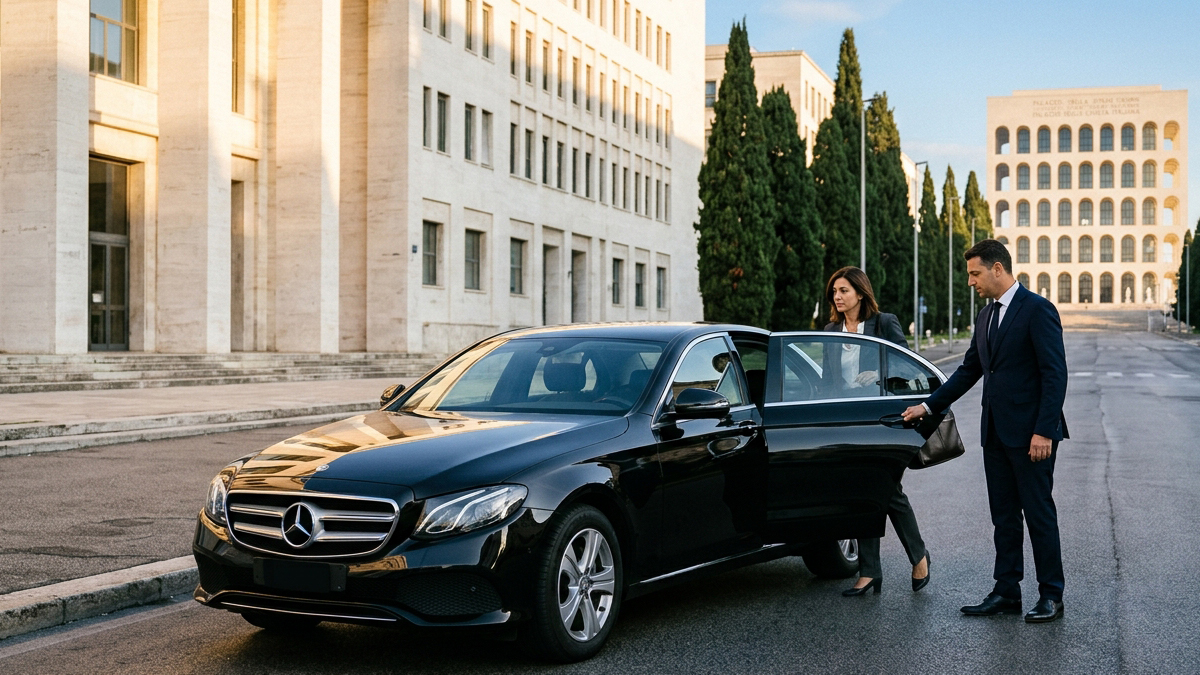
EUR, in the south of the city, is the planned district built in the late 1930s and finished after the war. It holds the headquarters of several large Italian companies, a cluster of ministries, and the EUR quarter's two main venues: the Palazzo dei Congressi and the Roma Convention Center La Nuvola. If your invitation says La Nuvola, Viale Europa, or Via Cristoforo Colombo, your work is in EUR. The streets here are wide, the buildings are travertine and symmetrical, and the district empties out in the evening.
The centre and the north-west — the historic core, Prati, Parioli — is where professional services, law firms, embassies, trade associations, and most smaller client meetings sit. The addresses are narrow-street addresses: Via Veneto, Piazza di Spagna, the streets behind Piazza Cavour.
There is a third pole worth knowing about. Fiera di Roma, the trade fair complex, is not in the city at all — it sits out towards Fiumicino, closer to the airport than to the centre. If you are attending a trade fair rather than a conference, the calculation changes completely.
Where to stay if your work is in EUR
Stay in EUR. It is a less interesting evening than the centre, and that is the trade-off, but a ten-minute walk to your venue on three consecutive mornings is worth more than a view.
EUR sits on Metro Line B, which runs directly to Termini and the Colosseum, so the centre is roughly 25 to 30 minutes away by train when you want dinner somewhere older than 1938. The practical argument for staying here is the morning: you are not crossing the city during rush hour, in a taxi, with a presentation to review.
Where to stay if your meetings are in the centre
Prati is the quiet recommendation. It is residential, walkable, well-served by Metro Line A, and it has the city's best concentration of ordinary good restaurants that are not priced for tourists. You are a short ride from most central business addresses and a ten-minute walk from the Vatican if you have an afternoon free.
Parioli is quieter still and suits longer stays, though it is further from the metro.
The historic centre itself works if your meetings are genuinely inside it — but understand what you are buying. You will be in a restricted traffic zone, which affects how cars reach you, and you will pay a premium for rooms that are often smaller than their EUR equivalents.
Getting around: what actually works on a working day
The metro is fast, cheap, and limited. Two main lines, A and B, cross at Termini. If your hotel and your meeting both sit near a station on the same line, the metro beats everything else. Rome's historic centre, however, is largely without metro coverage, because you cannot dig in it.
Taxis are metered and reliable at ranks, less reliable hailed. The real problem on a business day is not cost but predictability: you cannot schedule a taxi for 8:15 with any confidence on a rainy Tuesday.
A private driver booked in advance solves a narrower problem than a taxi does, which is why it fits corporate travel specifically. You know the pickup time, you know the price, and the car is there whether or not it is raining. For a day with three meetings in three districts, one driver who waits between them removes the part of the day most likely to go wrong.
The ZTL, and why it matters more than you expect
Rome's historic centre is a Zona a Traffico Limitato — a restricted traffic zone enforced by camera. Driving in without a permit produces a fine that arrives by post weeks later, sometimes several of them.
Current hours for the Centro Storico zone run approximately Monday to Friday 06:30–18:00 and Saturday 14:00–18:00, with a separate night restriction on Friday and Saturday from 23:00 to 03:00. Trastevere, San Lorenzo, and Testaccio have their own zones and their own hours. These change, so confirm against Roma Capitale before you travel.
The practical consequence: a rental car is the wrong tool for business travel in central Rome. A licensed NCC vehicle holds the permits to enter these zones, which means a driver can collect you at your hotel door rather than at the nearest boundary three streets away with your laptop bag.
Airport logistics on a short trip
Fiumicino (FCO) handles nearly all long-haul arrivals and sits about 30 kilometres south-west of the centre. The Leonardo Express runs non-stop to Termini in 32 minutes, which is excellent if Termini is where you need to be and you are carrying one bag.
On a two-day trip with an evening arrival and a morning meeting, the calculation is different. Arriving at 19:40 after nine hours in the air, the thing worth paying for is not speed but the absence of decisions. More detail on both airports is in our Fiumicino airport transfer guide, and the route itself is covered on our Fiumicino to Rome service page.
Three details matter for corporate bookings specifically, and they rarely come up unless you ask. Flight tracking means a delayed arrival does not forfeit the transfer. A fixed price confirmed at booking can be invoiced to a company account instead of reclaimed through expenses. And a vehicle sized for the group — a Mercedes E-Class or S-Class for up to four, a V-Class for up to seven — means a leadership team arrives together rather than in three taxis at slightly different moments.
Plan the ground transport before you book the room
TK Limo Service covers Fiumicino, Ciampino, Civitavecchia port, and point-to-point transfers across Rome, with fixed pricing, flight and ship tracking, meet and greet with a name sign, and tolls included.
See our full list of services, or send your itinerary by WhatsApp to +39 328 123 0555 and we will quote the whole trip, including the EUR-to-centre runs most people forget to budget for.
Frequently asked questions
Where is the best area to stay in Rome for business?
It depends entirely on where your meetings are. Stay in EUR if you are working at La Nuvola or the Palazzo dei Congressi. Choose Prati for meetings in the historic centre or Vatican area — quiet, walkable, on Metro Line A, and better value than the centre itself.
How far is EUR from the centre of Rome?
About 8 kilometres. Metro Line B connects EUR to Termini in roughly 20 minutes and runs frequently. By car, allow 25 to 45 minutes depending on the hour, since Via Cristoforo Colombo carries heavy commuter traffic in both directions.
Can I drive a rental car in central Rome?
Not into the historic centre without a permit. The ZTL is camera-enforced during posted hours and fines arrive by post. Licensed NCC vehicles hold the required permits, so a private driver can reach addresses a rental car cannot.
Is the Leonardo Express better than a private transfer from Fiumicino?
For a solo traveler with hand luggage heading to Termini, yes — it is faster and cheaper. For an evening arrival, a group, checked bags, or a hotel away from Termini, a private transfer removes the station transfer and the last-mile taxi.
Can a private transfer in Rome be invoiced to my company?
Usually yes. A fixed-rate transfer booked in advance can normally be invoiced to a company account rather than settled individually and reclaimed through expenses. Confirm it at the time of booking and provide the billing details then, since adding them after the journey is slower and sometimes not possible.
How much time should I allow between meetings in different Rome districts?
Allow 45 minutes between EUR and the centre, and 30 minutes for journeys within the centre. Rome traffic is less predictable than the distances suggest, and one-way systems around the restricted zones add time that mapping apps tend to underestimate.